



If you catapult a round ball, you can estimate where it will land with some practice and mathematics. If you catapult a pigeon, all you’ll get a bird flying away and eventually landing somewhere you couldn’t predict, no matter how many times you do it.
That’s the nature of complexity, and that’s where much of our work sits.
Welcome to The Design Loft #64.
In this issue, we’re going to look at complexity and start a conversation about what it means to design for living systems, including human behaviour. And to begin this discussion, we’re going to talk about pigeons.
Flying Blind In Living Systems
Complexity is part of living systems. It’s the reason why children are different from one another, even if growing up in the same household, even if they share the same genes. It’s why your garden vegetables grow differently from row to row, year to year. It’s why every patient experience is different from one another, even when people have the same underlying conditions.
There are many similarities and patterns, but the ability to predict and control much of what we experience in living systems is largely futile. Yet, we try. We use “best practices” when they are — at best - guidelines coupled with situational awareness. At worst, they are attempts to cover up what we don’t know.
In his new book, The Pigeon Test, Mark Eddleston illustrates how complexity is manifest in organizations using the example of the catapult mentioned earlier. The book is one that I highly recommend as an easy and breezy read of a topic that is anything but easy. That’s a compliment, because one of the biggest barriers to understanding complexity is that it is often poorly explained, or written in ways that are either polemical, highly technical, or inaccurate. There are relatively few good, accessible books that can serve as a starting place for people interested in complexity and serious about learning more.
The Pigeon Test meets this criteria.
What Eddleston leads with is a story told to him by one of his early teachers to frame an argument over why much of what we do is ineffective or at least nowhere as useful as we think. We — change makers, leaders, clinicans, consultants, advisors, and teachers — want to help people change from unhealthy, disfunctional, ineffective, or outdated behavioural patterns to something better.
We want to make a difference.
But are we? I’ve argued that evaluation — that data gathered from what we do — is critical to good design to know whether we are or not. But that’s just half of the story, the other half is whether our designs (our interventions in the world) are fit to create the change we want to see. Part of the reason for this is: complexity.

With complexity, we are often flying blind. And the first lesson in flying blind is knowing you’re blind. The second is that you’re flying.
Knowing Your Transformation Space
What understanding complexity does is get us to think about what the role of our designs are. Are they to deliver a consistent experience? Is it to deliver reliable, valid, predictable outcomes? Is it to inspire change in human behaviour? Might it be to transform an organization or mobilize a community?
The answer to these questions can shape whether we are dealing with a system that is more amenable to designs that offer us prediction and ‘best’ practices, or something else. Which brings me to another book that’s just been released that can serve as the next in your complexity reading list: The Cynefin Company Field Guide (Volume 1) by Dave Snowden and colleagues. This gets into more about how to recognize and make sense of the systemic conditions you find yourself in.
More on that book in future issues.
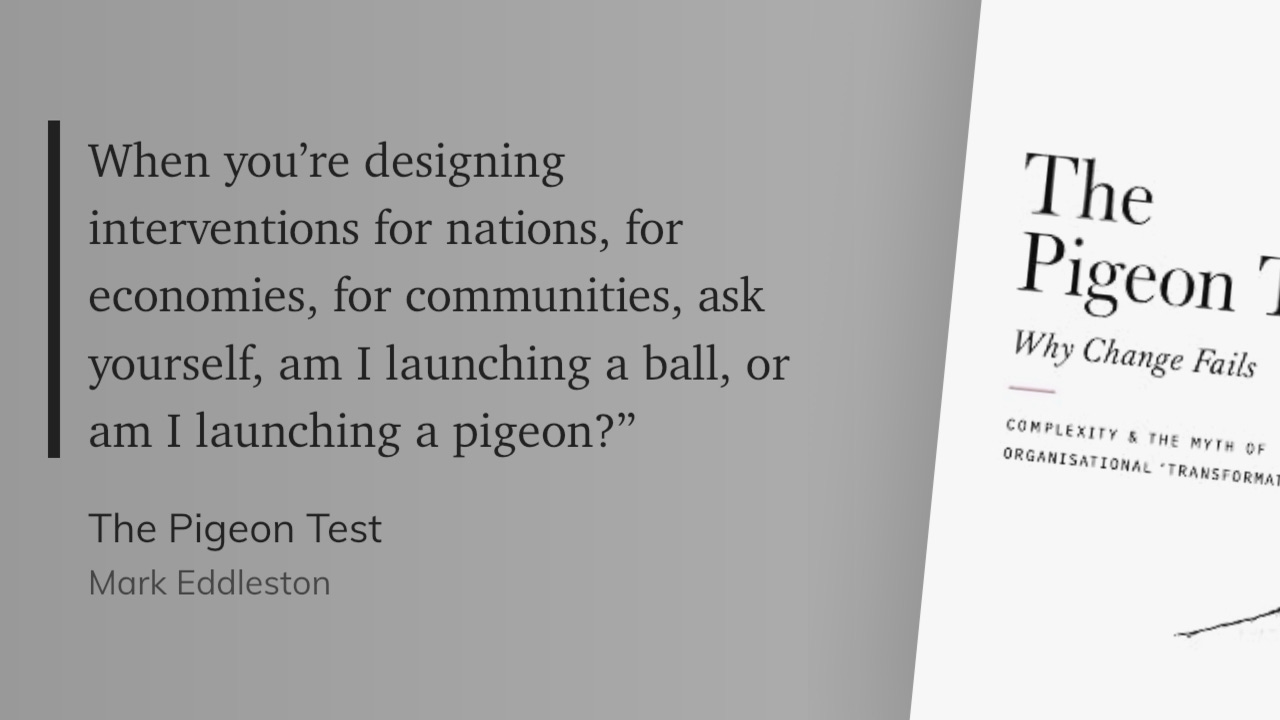
For this one, I’d like to leave you with a quote from Eddleston’s book and offer the recommendation that you consider deeply what kind of system you’re working in and what you want to achieve. It’s too often that we designers seek to influence people with clever products or services to be used in predictable ways, when in reality , people are looking for things that adapt, shift, and mould to their circumstances in ways that require a different kind of design, and one that is far less ego- or style-driven, and more about living systems.
In other words: are we launching a ball or launching a pigeon?
Practice Notes and References
If you’re looking to learn more about complexity and don’t have a clear sense of where to start, or how to approach the topic, here are some recommended resources and people for starting out:
Censemaking. For nearly 20 years I’ve been writing a blog on complexity practice and design, written for practitioners.
Of course, Mark Eddleston’s new book is a great start. Links and references can be found on his Substack by the same name as the book.
Getting to Maybe is an older, yet still highly practical book for people trying to understand how we create change amidst complexity.
Jennifer Garvey Berger is one of my favourite authors of many books that take a complexity-oriented lens to organizations. Her work is scholarly, yet practice oriented.
I’ve appreciated the way practitioners Chris Corrigan and Sonja Blignault write and communicate about complexity in their work. They are great writers and bring much experience, humanity, and humility to their work in complexity. All three of us are deeply familiar with what was once called Cognitive Edge training materials and methods in the past and share an interest in creating change while attuned to complexity.
Cognitive Edge, now the Cynefin Company, and its founder (Dave Snowden) are behind the other book recommended above. Snowden is a wise thinker and leader in the complexity space. His work is a little more advanced — drawing on many areas of scholarship, theory, and philosophical positions — but often entertaining and sharp in intellect and tongue.
You’re such a good teacher.
I read The Pigeon and did not hesitate purchasing a copy when it was released. It’s such a good book, clearly describing complexity in organisations.