


Welcome to The Design Loft #58
The foundations of design are tied to the capacity for people to create things of value for humans and the planet. This is where we can directly affect health and wellbeing: by creating better. This is the ethos behind The Design Loft.
Design is about creation of ideas, knowledge, and the things (products, services, policies, and systems) that emerge from applying focused thinking, making, and deployment of our energy toward a problem worth tackling.
The most widely discussed of these is design thinking. I’m not going to get into the many debates over the name, the role, the qualifications and function associated with how this term has been used. Rather, I’m going to present you with what I see as the core of design thinking as part of a larger set of design foundations, which I introduced in the last issue.
These are my ideas drawn from a career working in design thinking and innovation. I hope they make you think (and design).

Design is about creation of ideas, knowledge, and the things (products, services, policies, and systems) that emerge from applying focused thinking, making, and deployment of our energy toward a problem worth tackling.
Design Thinking
Design thinking is the starting point for design. Unlike what has been popularized, it’s not the end. Yet, without strong depth of design thinking, we will not have a clear sense of what it is we are seeking to develop, who’s needs are being served, and what kind of problem conditions we will face.

Thinking is more than just musing on something, it is about the ability to see something in the mind’s eye and work with it. This means being able to see things that aren’t there, in time and space that are fluid and dynamic. Design thinking challenges us to connect to our past (memory), exploring the present space where problems and situations are manifest, and imagine possible futures at the same time.
This involves seeing situations, envisioning options, and doing the work to explore the problem domain to guide a designed thing.
I’ve much to say on design thinking. Its array of uses, meanings, and the many voices promoting it or decrying its existence have made it far more messy than I’d like. It is sufficient to say that for my purposes and that of most people seeking to innovate, design thinking is an important vehicle for taking the abstract and transforming it into something real and possible.

Qualities and Features
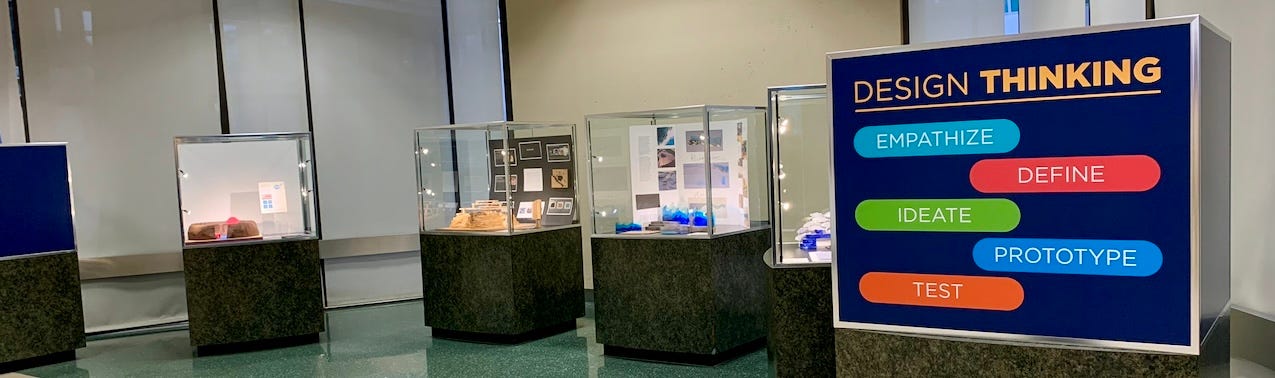
Design thinking involves the following qualities and requirements:
1.Recognize. Paying attention to the world and the recognition that there problems exist and that they can be either solved or addressed in some ways to improve the conditions surrounding them is the first step toward design. Not all problems can be solved, but many can. Recognition is what separates King Cnut commanding the tides to stop (and expecting obedience from nature) from a Mahatma Gandhi who sees a pathway for people to live differently.
2. Identify. The recognition of a situation or problem takes us down a journey of identification of how or whether it can be addressed by design. Identification comes from taking a closer look to perceive imbalances, inadequacies, performance issues, or gaps where opportunities exist for something better that we can change through our efforts. It’s through identification that we spot opportunities.
3. Envision. Once we’ve identified something, can we see a better future? What does it look like? What might improvement look like in product, outcomes, or both? Envisioning the future is involves an ability to dream of something better and can serve as a force to seek that out and create the future we want.
4. Conceive. With a problem identified and possible futures envisioned, we must now conceive of what will get us to this preferred vision. Generating ideas, models, hypotheses, examples, or scenarios is part of conceiving something. Design thinking is most known for this part of the process; it’s where we begin with our ideas and convert them into conceptual prototypes that we’ll eventually make.
5. Research. is the means to honour the work that’s already been done so that what we do next builds upon it. Research helps us see what else has been done, what additional features need to be considered (or removed), and what factors might influence what we make and how it is received when implemented into the world. Research is also where we bring in empathy and perspective taking, gathering stories and generating evidence to support our planning.
6. Plan. This is where we take our research, ideas and aspirations and translate into a plan of action. This is also where design strategy comes in: where we connect the intentions, values, resources, skills, and requirements together and translate it into an approach as well as a set of tactical and operational actions that we believe will achieve an outcome.
7.Communicate. Design requires us to communicate our aims, intentions, plans and expected outcomes to those we seek to serve and those we aim to convince. This is the first space where persuasion comes into the design process, but not the last. Without an ability to translate abstract ideas into something understandable to others, our designs won’t go far.
8. Enlist. Design is a team sport, and rarely done all on our own. Whether its seeking input from a client, collaboration on the process, or full-on co-design, bringing people into the conversation and process is a critical factor worthy of noting as a design skill. Enlisting and enroling people in a process of integrity and purpose is one of the benefits of design.
Practice Notes
Design thinking is much like undertaking strategy: it requires an intention, focus, and connecting different parts of a system of activities together in a coherent manner. There is no single best practice for design thinking, however, there are some general principles for enkindling it and some things to avoid. Some of these are:
Give yourself time and space. Design thinking requires room for your brain and perceptive abilities to adjust to the conditions for creative exploration. Don’t rush things and expect great results. Don’t try to wedge creative exploration into crammed, unfocused schedules.
Embrace constraints. Limitless time, space, and resources are as harmful to design as suffocatingly tight limits. Embrace the constraints you have and work with them. Design is about creating good, not perfect.
Failure is the option. Relax the need to make things right the first time. Failure -- or rather, failure to meet expectations -- is a part of the design process. You’ll learn as you go.
Look and listen. Feedback is the means in which we learn as we go: we pay attention to what connects with people, what produces results we want, what’s extraneous, and what’s essential. We’ll rarely know this ahead of time.
If we understand design thinking, the next step in setting our foundation is making things. This next part of the design process is what we’ll focus on next.
Image Credits: Cameron Norman