


Among the many qualities that design brings to work in health is that we can see future possibilities beyond the present situation.
This was true with a recent event held at Rotman School of Business at the University of Toronto, called The Picture of Health. At this event, four speakers outlined what they saw as opportunities to answer the following question: what would our health system could look like if it could be redesigned from scratch? Collectively, the speakers along with about 100 others in attendance, began asking some big questions:
What would we do differently? What we do the same?
Where are the big opportunities?
Where are the levers of change?
What was left unfinished when we designed the health system we have?
These are the kind of questions that can be asked when we release ourselves from what is and shift it to what could be.
This is where futures thinking becomes practical, and its as important part of strategic design for health as anything we do.
Foresight and Health Futures
It’s tempting for some to view these hypothetical exercises as mere folly, but futures thinking is a vital part of what connects design to outcomes.
You can’t design a system or service unless you’re able to envision what it can look like.
While we may not know exactly what it will look like, there are compelling reasons for why we want to take the time to engage in the kind of discussion that I was privy to on a sunny Monday evening in May in Toronto.
Shifting mental models. Among the highest points of leverage we have in a system is to change the mental models we hold. Futures thinking frees us from relying heavily on what is, and enables us to imagine what could be. Knowing that what we are doing is hypothetical can serve to relax the constraints in our thinking about how something is funded, or who is responsible for certain functions, or what kind of political will there might be. By looking at the end product — or products (plural) — we might find solutions that exist in plain sight.
Surfacing hidden assumptions about use. Tied with mental models are the assumptions that go with them. An exercise I used to do in teaching systemic design and health behaviour change was to have students explain to me the pathways to get to a specific building across campus. If I was to go from A to B, how would I do it? Students would volunteer a variety of answers, most often prioritizing (without realizing it) speed, convenience, and distance. As we were in a multi-story building, none of them suggested that we rappel down the side of the building, up the one across the street, and over many others (which would have been the straightest route). We could have also gone to the corner, take the subway to the very end of the line, board a train into another part of the city, take a bus from there to the building across the way. Or what about tucking into the sewer system? The point wasn’t for absurdity, rather it was an exercise in identifying priorities and preferences. It also surfaced issues around safety, accessibility and circumstances which were not immediately obvious in the initial exercise.
Sometimes there’s a kernel of practical genius in the absurd.
Recognizing origin stories. Every system started from something, even if it was just something else. A reminder of what the future holds is that the systems we have now, imperfect as they are, began as something. So, too will the future systems. It can begin today.
Inspire possibilities, shaping design priorities. The ideas that were discussed for how we might create a better health system reflected the perspectives of those in the room, which because of its location (a school of business), was more angled toward technology and data. Nevertheless, the priorities identified were practical and focused on the gaps in the current system by identifying what was possible when designing a new system. Investors were speaking with policy people, health leaders were connecting with designers, and clinicans were speaking with technology developers. By enabling people to see something that was possible, connect it to what they were doing, and creating conversation points around it, the health futures exercise created space for a form of dialogue that wasn’t possible before.
Inclusion perspectives. Lastly, futures allow us to imagine a world where people aren’t excluded, or to see futures where they are from new perspectives. When I tell you what a world could look like, I’m hopefully inviting you to participate. Could we make health better for people who have different needs, wants, preferences, and capacities than is currently served by the existing system? Yes. And in shaping that vision, we begin to see where our current systems fall flat.
Together, seeing the futures enables us to create a different future.
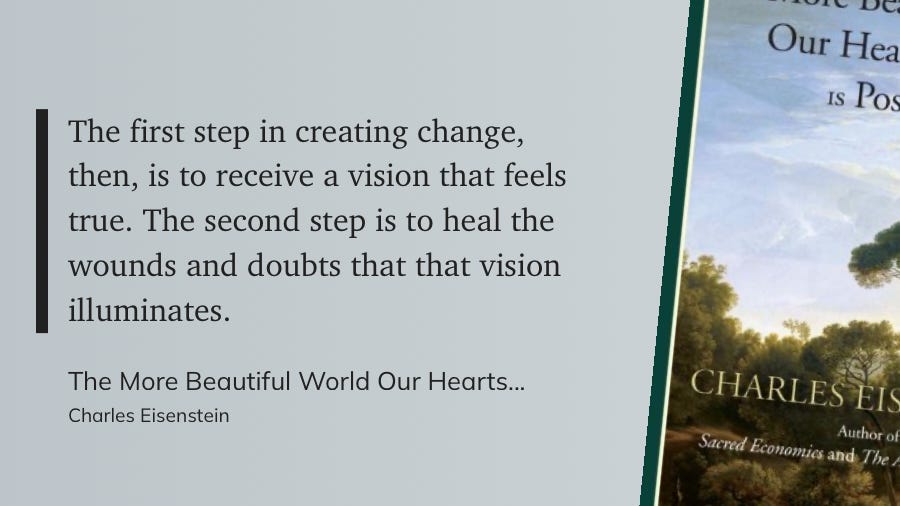
To draw on the words of Charles Einsenstein, we need a vision of what’s possible before we begin to health ourselves and the systems we design for health.
Thanks for reading.
To learn more about what the Design Loft training and support program looks like, reach out or sign up to become a member.