


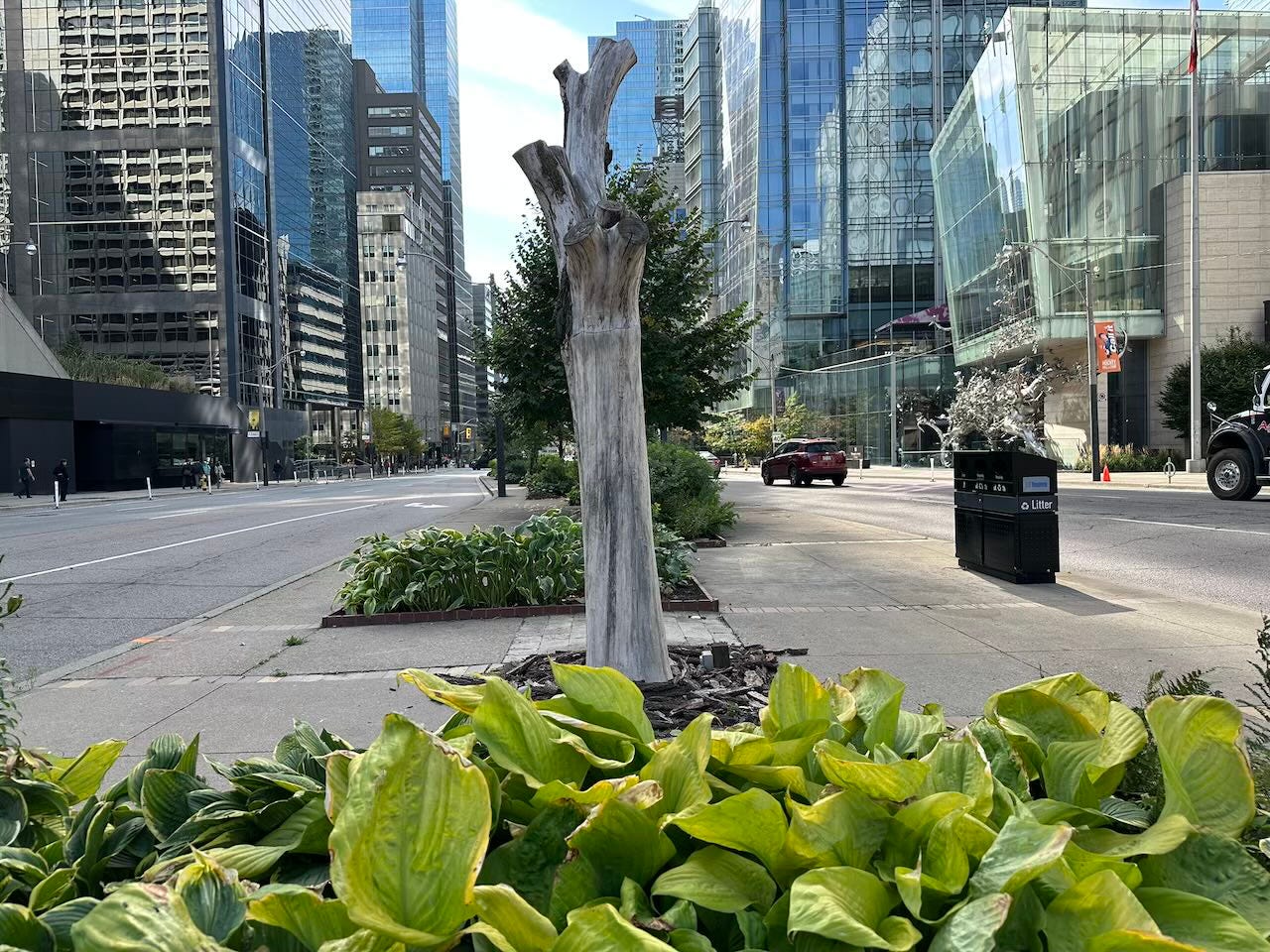
The image above provides a stark contrast of textures — the lush green of the plants situated among glass, steel, automobiles, and tarmac with a dead tree in the middle. This image is a suitable prompt for understanding two of the most important aspects of design: purpose and context.
It’s easy to forget the spaces in which we design in to and why.
For example, we design initiatives to support patient communication, yet implement them in loud, cluttered, hectic clinical settings.
Or, to use the example pictured above, we decide to plant trees in places where they aren’t able to grow and thrive.
Let’s explore this. What is it that trees are expected to do in the city? They might provide shade, contribute to reducing pollution, and offer an aesthetically pleasing complement to the human-made environment.
Now let’s take our inquiry another step further. Why do we need shade? To combat the effects of sunshine and growing heat events that amplify the effects of having concrete, pavement, and steel cities in high concentration. Trees help clean the air because of the pollution that urban life — vehicles, equipment, materials — produce. We also know that nature can provide a calming effect, partly by creating a natural, colourful contribution to the visual landscape.
What its purpose? Promote health and wellbeing in living systems. The context is the urban environment.
Noticing Purpose and Context
The technique we just explored can be used within any context.
It’s a simple means of slowing down, noticing what is around us, and asking questions about the purpose of what we are doing at a fundamental level. This approach also allows us to notice when our designs are at cross-purposes to one another.
Whether its urban environments, healthcare settings, schools and places of learning, or others — we often have multiple layers of design taking place.
To use the example above, we have a city that is designed to provide places for people to live and work, pathways to get to those places, and settings for eating and drinking. These are important for a functioning society, but they also bring with them health and social impacts that negatively influence the outcomes that these designs seek.
We can begin to surface these tensions between different design effects by asking: 1) what is [our design] being asked to do? and 2) in what context is it being asked to do it?
By asking ourselves these questions in whatever context we work, we can start to see areas of opportunity, contradiction, and identify what kind of outcomes we can expect.
The (Evaluation) Outcome Gap
Understanding the gap between our aims and context matters not only for our designs (the inputs), but our evaluations (outputs and outcomes).
If we are evaluating the impact of what we create — a program, policy, service, or product — we need to understand the role of different forces in shaping the outcomes. It is possible — and often the case — that we fail to see the desired outcomes from our work because of these countervaling forces that influence our designs.
It is another reason why connecting design and evaluation is so critical as we can, and do, mistake or miss the connections between causes, effects, and consequences.
Designing for our environment means more than placing things in a context, it’s also about understanding how our different designs come together in the same space.
Thanks for reading The Design Loft. For more on how to use design and evaluation to create and sustain impact, please subscribe. For additional support, please reach out and let’s talk. I can be reached at > https://www.cense.ca/censemaker/
Seems that peering through the design lens is likely to lead to a better understanding of what's more important to evaluate. (Those hostas in the picture for instance. Did the folks know that deer love to eat those and word is getting around and a massive herd of deer is on the way to the city for lunch today?)