


I was recently supporting a loved one undergoing cancer care, which required a trip to the hospital’s cancer treatment centre. Radiation therapy is a non-invasive form of treatment that requires many visits over weeks, done almost entirely on an outpatient basis. It’s remarkable when you think about it.
But, like many technology-centred treatments, the facilities required to undertake the treatment are sequestered in isolated, windowless rooms, away from the public eye. Cancer treatment is scary for those getting treated and their loved ones.
It’s for that reason that the environment around which the cancer treatment takes place, is so important. This is where cancer care takes place, not just treatment.
Care-ful Spaces for Health
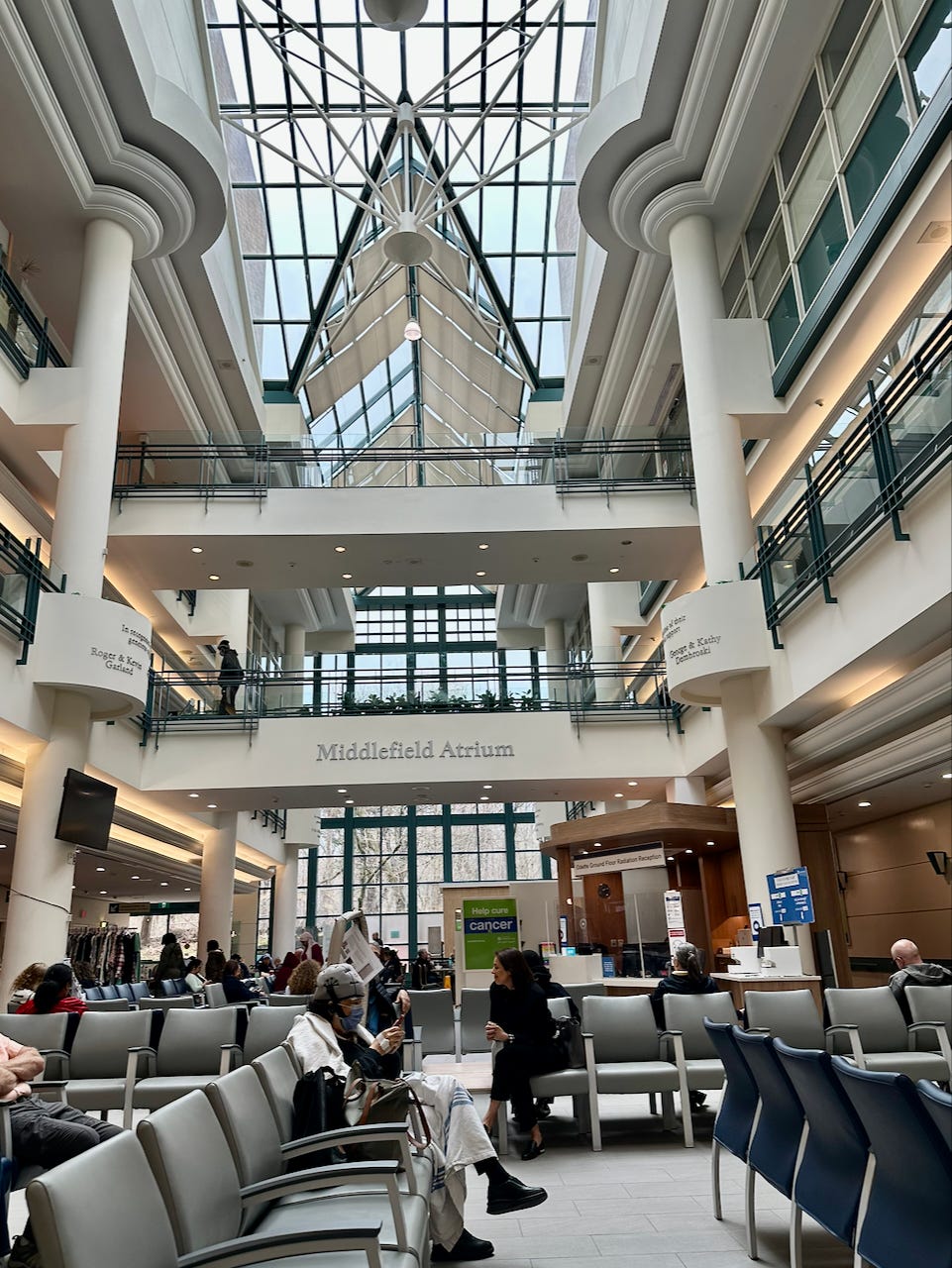
The image above provides a glimpse of what designing for a care-ful space could look like. There’s lots of natural light. There’s plenty of room between the chairs to move — and lots of chairs so people can congregate together or find enough space to maintain distance should people wish to be alone. The chairs are also situated in different directions, to add a bit of variety and vibrancy to the space, instead of making it like a waiting room at the government services branch where everyone watches for their number to be called.
The atrium features a soaring glass canopy over the entire space, which is located in the basement of the treatment centre (although you might not know it from seeing the picture). You can see greenery from outside through the windows. There’s a cafe where people can mingle on the far side.
The radiation technicians come out and personally greet everyone when their time has come and walks with the patient and their caregiver into the treatment area.
I opted to wait out in the atrium (the actual treatment area is dark, cramped and windowless) and thought that the architect and the health centre leaders got this important part of the treatment journey right. Sometimes technology, privacy needs, or existing structural elements limits our design choices, but for where there is room, we must take it.
Health is produced out in the world, not just inside our cells. It’s repaired and treated using tools like medical linear accelerators, gamma knifes, and with surgical tools or pharmaceuticals. If we are looking to increase health-ful spaces and care, considering what kind of environments we create — and the services designed to flourish within those spaces — are one of the most powerful ways to do it.
Designing for care? Consider the systems and spaces you’re doing it in.
Thanks for reading.
In good health, Cameron.