


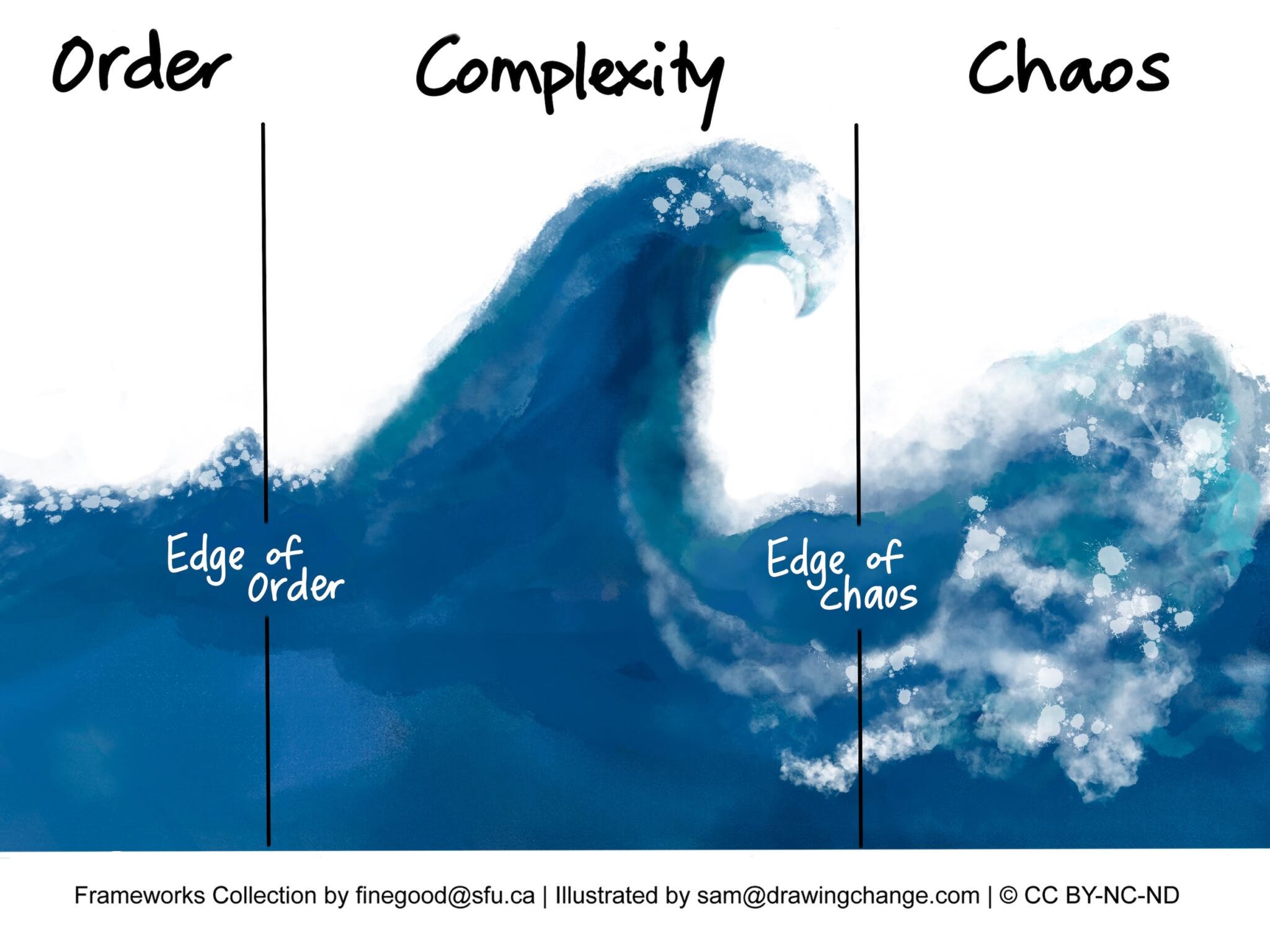
Systems thinking is about understanding how things are organized and interact within a given context. It’s not about looking at individual behaviours or interactions, but how they come together and how situations are configured to begin with.
Systems thinking is a big part of strategic design. When we understand the systemic context we’re designing for, we can create better, more sustainable designs.
In this issue of The Design Loft, we’re taking a look at a framework that helps us do that: The Cynefin Framework.
Sensemaking and Complexity
The Cynefin Framework (pronounced (/kəˈnɛvɪn/ kuh-NEV-in)[1]) is a sense-making tool developed by Dave Snowden that helps practitioners recognize and distinguish among different types of situations we encounter in our life and work. The Framework helps us determine appropriate responses to situations and guide our design choices, so we work from a set of conditions that allow us to succeed.
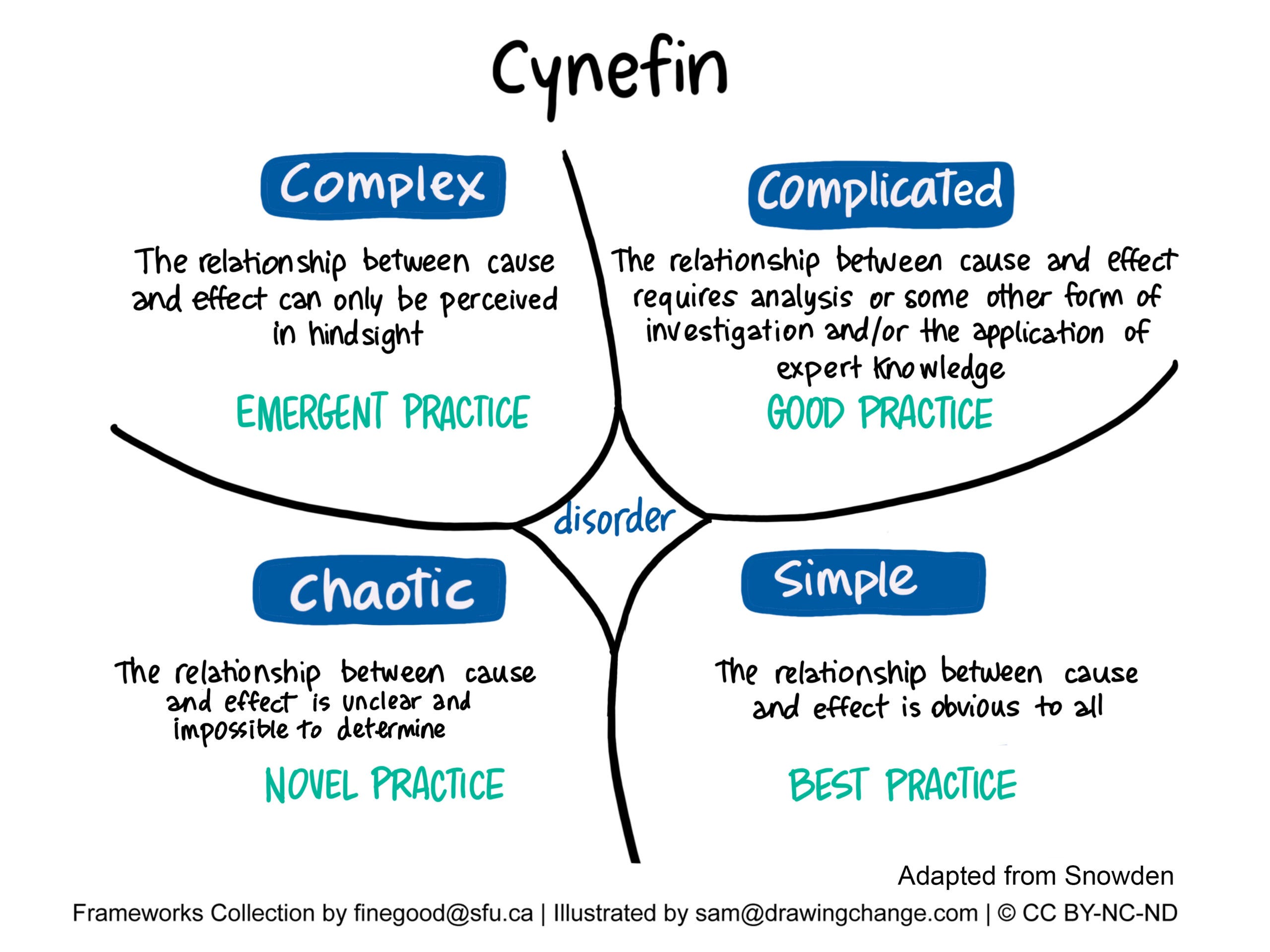
The framework (above) identifies five domains: Clear (formerly called Simple/Obvious), Complicated, Complex, Chaotic, and Confusion/Disorder. Each domain requires fundamentally different approaches to decision-making and action. In Clear contexts, best practices apply, and cause-and-effect relationships are predictable and repeatable. Complicated situations require expert analysis to navigate multiple possible answers, and often involve many different interactions, yet with some level of predictability. Complex contexts—where most strategic innovation work occurs—are characterized by emergent patterns where cause and effect are only visible in retrospect, requiring probe-sense-respond approaches rather than analysis-first methods.
Chaos is that state that’s often fleeting, but intense and involves many things happening at once, so that we are unable to apprehend order and require some form of activity to make meaning of what’s happening. The fifth domain, Confusion, represents situations where it’s unclear which domain is most applicable. Cynefin can serve as a practical diagnostic tool for matching intervention strategies to actual system conditions and enable us to test our assumptions.
Making Sense of Complexity
Much of the work we do in health and social impact falls within the realm of the complex. We have many different actors, agents, structures, and interactions that overlap at different time scales and intensities, creating a myriad of influences upon the outcomes of our work. Even in straightforward clinical contexts, we find intersections among the setting, a patient's or client's personal history, and the clinician's experience and approach, introducing variations and complexity. Most of our clinical contexts are anything but straightforward.
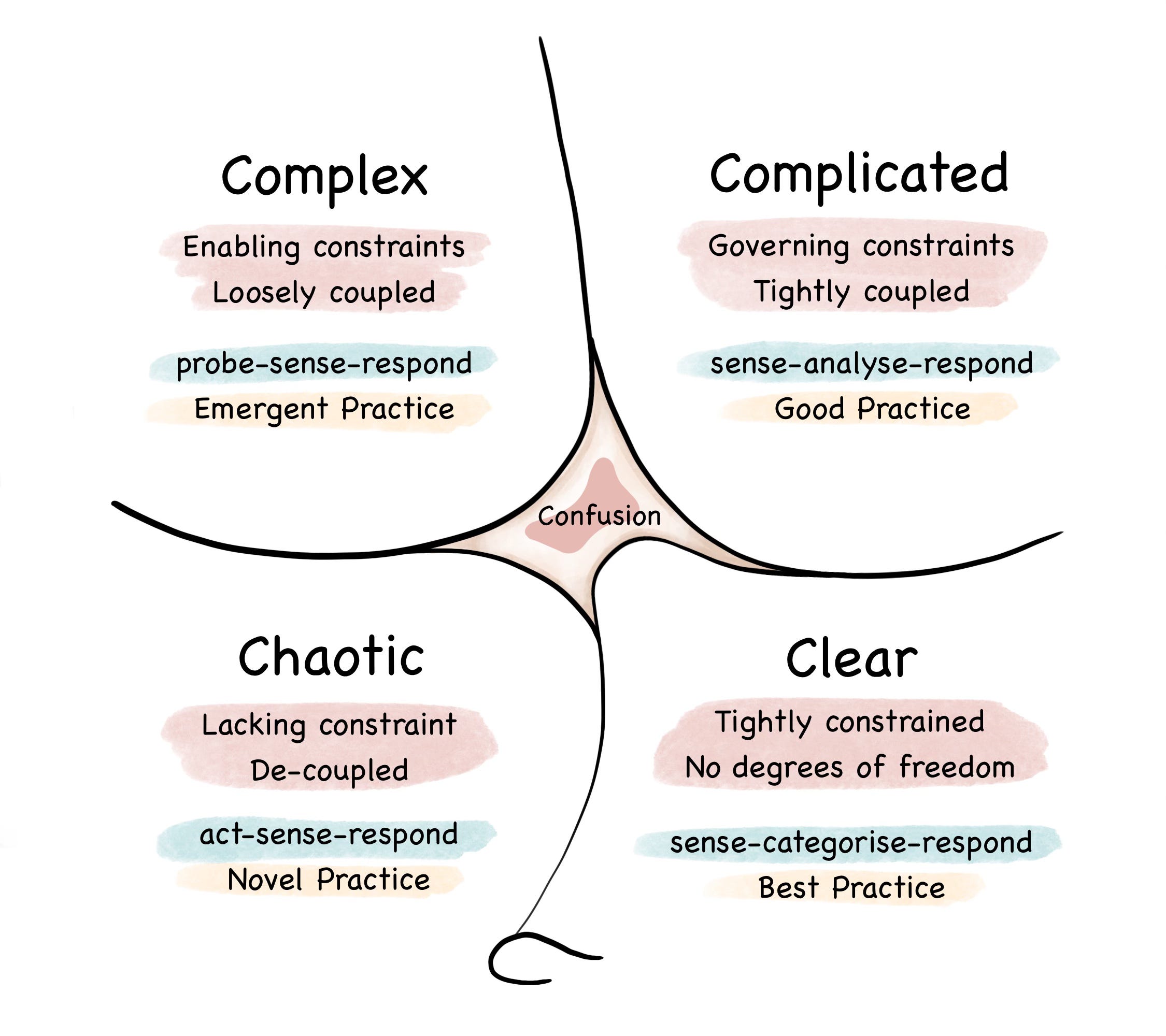
The Cynefin Framework provides us with some means to sense-make our experience by organizing it into (and across) quadrants. By organizing things, we are better able to design approaches that fit. If you look at the framework above, you’ll see three different colours within each category.
Looking at the image above, the top (red) refers to the role of constraints. Every system has natural or imposed constraints that shape its context, and these constraints are expressed differently across system types.
The middle colour (teal) provides guidance on how to engage with each system type. For example, in clear (sometimes called simple) systems, we can sense what’s happening, categorize what we see, and respond with a strategy likely to achieve specific outcomes. In complex systems, we might need to take some action first (probe) to see how the system reacts (sense), and then respond with a design.
The yellow section refers to the type of practice guidance we have, with clear systems being the only ones where best practice is discernible. Even in complicated systems, we might have good practice, but rarely ever know what is best because of the dynamism that takes place within the system.
You can see how comparing the two quadrants can have a massive influence on how we design. We’ll be looking at this in future issues, lessons and events.
Cynefin Contextualization
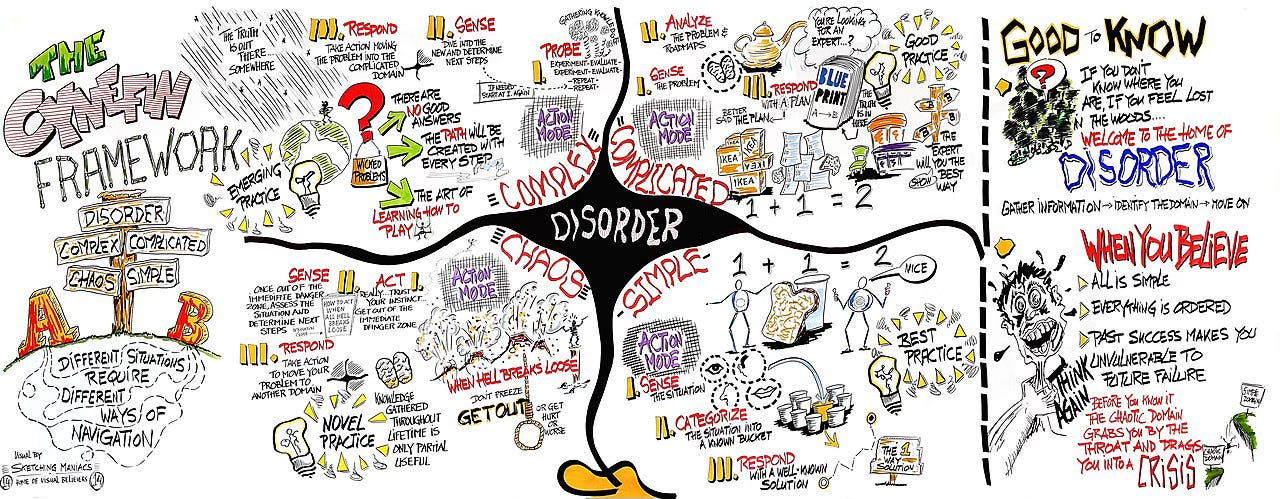
Chris Corrigan has a great explanation of Cynefin and how he’s applied it to different contexts, and writes about an important part of using the framework: Cynefin contextualization. As Corrigan explains:
It works like this: you literally put as many aspects of your situation on individual post-it notes as you can, put them in the middle of a table and sort data into basic categories according to these criteria:
If the aspect is clear and obvious and things are tightly connected and there is a best practice, place it bottom right.
If the aspect has a knowable answer or a solution, has an endpoint, but requires an expert to solve it for you, put it top right.
If the aspect has many different possible approaches, and you can’t be sure what is going to work and no one really has an answer, put it top left.
If the aspect is a total crisis, and you are overwhelmed by it, put it bottom left.
If you can’t figure out which domain to put the aspect in, leave it in the middle for now. NOT EVERY POST IT NOTE NEEDS TO GO IN THE FOUR OUTER DOMAINS.
These short-hand guidelines can be enormously helpful in using Cynefin to help you assess your situation.
In future issues, we’ll explore this further. Premium / paid learners will have the opportunity to explore how Cynefin has been used to support health system leadership and transformation. The references below will be our intial reading list and profile how Cynefin has been used in health contexts.
Cynefin is a tool I use often with my clients and students, and it’s helped them in making sense of the systems they encounter. I hope it does the same for you, too.
Thanks for reading.
References
Beurden, E. K. V., Kia, A. M., Zask, A., Dietrich, U., & Rose, L. (2013). Making sense in a complex landscape: how the Cynefin Framework from Complex Adaptive Systems Theory can inform health promotion practice. Health Promotion International, 28(1), 73–83. https://doi.org/10.1093/heapro/dar089
Glouberman, S., & Zimmerman, B. (2002). Complicated and complex systems: What would successful reform of Medicare look like? (Discussion Paper No. 8). Commission on the Future of Health Care in Canada. https://publications.gc.ca/collections/Collection/CP32-79-8-2002E.pdf
Gray, B. (2017). The Cynefin framework: applying an understanding of complexity to medicine. Journal of Primary Health Care, 9(4), 258. https://doi.org/10.1071/HC17002
Lane, P. J., Clay-Williams, R., Johnson, A., Garde, V., & Barrett-Beck, L. (2021). Creating a healthcare variant CYNEFIN framework to improve leadership and urgent decision-making in times of crisis. Leadersh Health Serv (Bradf Engl), ahead-of-print(ahead-of-print), 454–461. https://doi.org/10.1108/LHS-03-2021-0013
Snowden, D., & Rancati, A. (2021). Managing complexity (and chaos) in times of crisis. A field guide for decision makers inspired by the Cynefin framework.
Nachbagauer, A. (2021). Managing complexity in projects: Extending the Cynefin framework. Project Leadership and Society, 2, 100017. https://doi.org/10.1016/j.plas.2021.100017
Holly, M., Bartels, S., Lewis, N., Howard, P., & Ramaswamy, R. (2022). A learning approach to community response during the COVID-19 pandemic: Applying the Cynefin framework to guide decision-making. Learn Health Syst, 6(2), e10295. https://doi.org/10.1002/lrh2.10295