


If you’re attention wanders off while reading this, it might lead you to the most significant insight or sense-making you’ll do all day. Otherwise, try taking a shower.
Welcome to The Design Loft #63.
Manoush Zomorodi, a multi-hyphenate, curious, and former host of the TED Radio Hour was invited to give her own TED talk on the work she was doing on curiosity, discovery, and the brain. Among the central findings looking at the research and speaking with the researchers doing that work was that boredom — doing less — can allow us to do more.
It might sound counterintuitive, but then, that’s how much of design’s great gifts are and why doing less matters in designing for health.
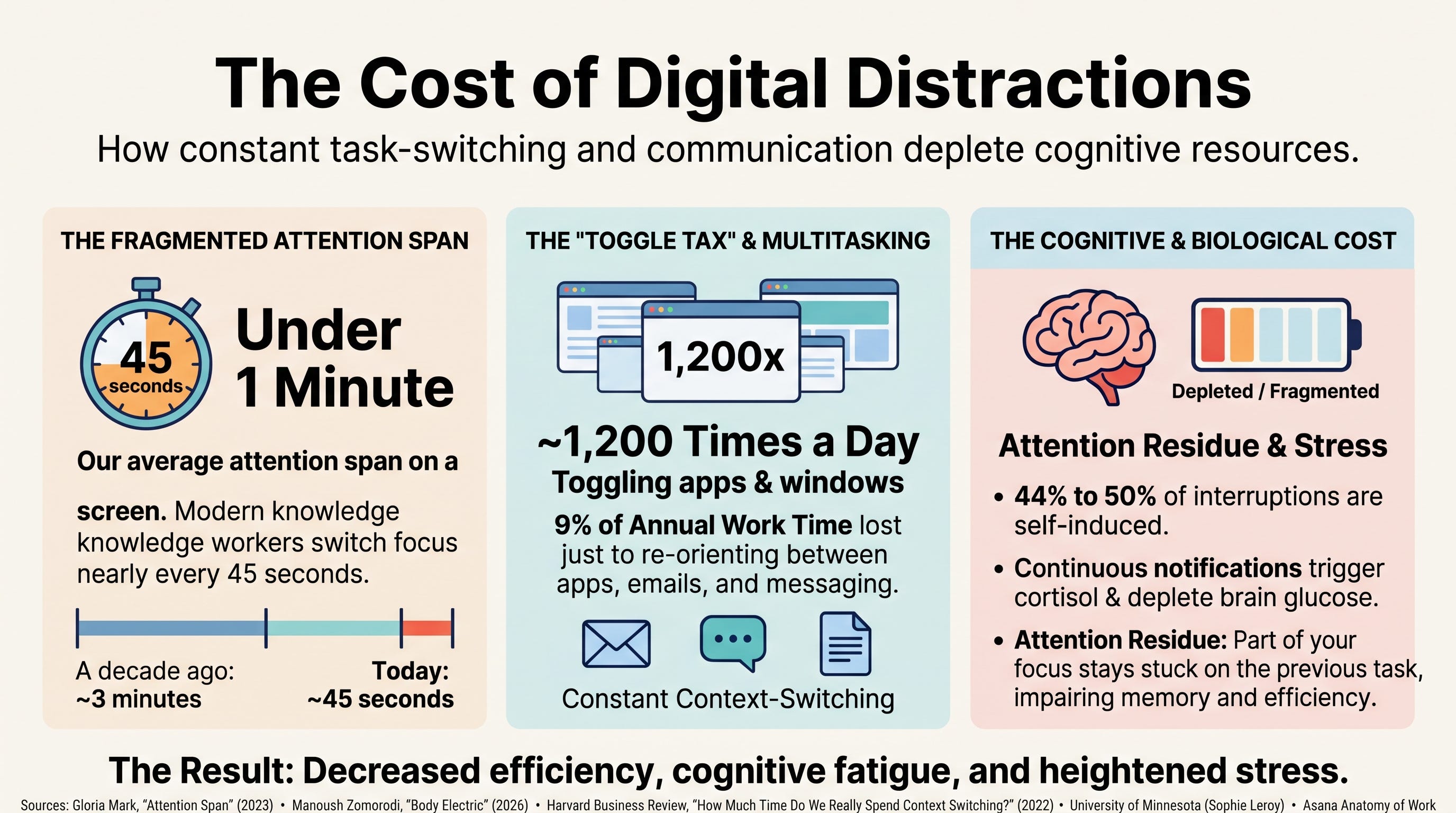
Every time you shift your attention from one thing to another, the brain has to engage a neurochemical switch that uses up nutrients in the brain to accomplish that. So if you’re attempting to multitask, you know, doing four or five things at once, you’re not actually doing four or five things at once, because the brain doesn’t work that way. Instead, you’re rapidly shifting from one thing to the next, depleting neural resources as you go. - Daniel Levitin, Neuroscientist, musician, and author
This quote above came from Manoush’s conversation with Dr. Levitin, who has looked a the neurochemical costs of task switching and how every decision we make uses up energy (glucose) that could be used for something. His message: use your energy wisely. Even decisions to ignore something uses energy.
The quote above was framed in the context of boredom: how removing yourself from the tasks, demands, stimulation, and requirements of our life — even for a short amount of time - can yield benefits by reducing the cost of what all of these things do to our brain.
Manoush goes on to say:
A decade ago, we shifted our attention at work every three minutes.
Now we do it every 45 seconds, and we do it all day long.
The average person checks email 74 times a day, and switches tasks on their computer 566 times a day.
This data came from 2017. Dr. Gloria Mark, who studies cognitive effects of task switching at University of California-Irvine and was interviewed for Zomorodi’s book, has noted that these figures continue to hold up, if not showing that they are worse.
If we want to design for health (of ourselves, the health workforce, and our patients), we might want to start designing for less, not more.
Designing For Health, Not Something Else
Designing for health and attention isn’t just confined to digital distractions, yet they are the amplifier. Why? Because they have been designed this way.
In the weeks and months to come, we’ll be sharing a new series looking at what people made and exploring the design ethos behind them. Many healthcare workers, social workers, rehabilitation staff, administrators, and educators don’t affect the health of their patients, clients, staff, and community as much as they could. In some cases, these workers create problems, not benefits for health. The reasons? The tools and systems they work in weren’t designed for health.
They were designed for expediency, cost controls, liability issues, convenience (for someone), or lack of consideration of who or what things were designed for. They weren’t designed for complexity or systems and the humans living and working within them.

This isn’t an issue of malice, neglect or incompetence, but a feature of a system that’s been designed for things other than health. These matters or considerations aren’t inconsequential, but what happens when they put together is that we end up “losing the plot” of why we’re doing the work we are.
The digital distractions we’ve discussed are a symptom of this. As we get more monitors, tools, equipment, regulations, and relationships built into the system, we increase complexity, and sometimes coherence and attention to the mission is the cost.
These features can be designed back in. It just requires a different way of working and thinking than it did when they were put in. That’s a big part of why The Design Loft exists.
Practice Notes
Rather than flood you with recommendations, I’m going to model the message of this post: Do less to do more.
To quote Zamorodi as she wrapped up her talk, maybe the way to creativity, insight, and better attention is to do nothing, rather than do something:
So the next time you go to check your phone, remember that if you don’t decide how you’re going to use the technology, the platforms will decide for you.
And ask yourself: What am I really looking for?
Because if it’s to check email, that’s fine -- do it and be done. But if it’s to distract yourself from doing the hard work that comes with deeper thinking, take a break, stare out the window and know that by doing nothing you are actually being your most productive and creative self. It might feel weird and uncomfortable at first, but boredom truly can lead to brilliance.
Thanks for reading.
Go out there and (try) to do nothing.
Image Credits: Photos by Markus Spiske on Unsplash and Philip Oroni. Illustration created with Gemini.
This was a good read this evening as I feel exhausted after a day of being torn in multiple directions, often from the demands of these digital platforms. Thanks for the well written reminder and the link to the YouTube TedTalk, I’ve loaded it and hope to listen to it this week!